

Which Sport Really Tests Human Stamina the Most?
This question keeps showing up on Google, social media, and everyday sports debates because people experience sports differently. A football fan sees nonstop running. A tennis fan sees players battling alone for hours. A cricket fan thinks about matches that last all day or several days. Everyone judges stamina through the sport they know best.
That’s why this topic never dies.
Most answers you’ll find online try to give a quick winner. Some say football requires the most stamina. Others claim tennis is the hardest. Many completely dismiss cricket or basketball with surface-level arguments. The problem is simple: these answers look at stamina from only one angle.
Stamina is often measured by how long a match lasts or by how tired a player looks at the end. That approach ignores intensity, recovery, mental focus, and playing conditions. As a result, many articles feel confident but don’t fully explain why one sport should rank above another.
The reality is that stamina isn’t a single skill. Each sport tests the human body and mind differently. Football pushes continuous movement and repeated sprints. Cricket challenges long-duration focus and physical endurance. Basketball demands explosive effort with fast recovery. Tennis combines physical exhaustion with intense mental pressure, often without substitutions.
So when people ask, “Which sport requires the most stamina overall?” they’re usually asking the right question but expecting the wrong kind of answer.
Instead of forcing a single winner, this article sets a clear expectation from the start: there may be no single sport that wins in every definition of stamina. The real answer depends on what kind of stamina you’re talking about—physical, mental, continuous, or high-intensity recovery.
Understanding that difference is the key to a fair comparison.
1. What Does “Stamina” Actually Mean in Sports?
Before we dive into comparing football, cricket, basketball, or tennis, it’s important to clarify one thing: stamina is not just feeling tired. Many people, and even some articles online, confuse visible exhaustion with actual stamina. In reality, stamina is the body and mind’s ability to perform consistently over time, even under physical and mental stress. Without understanding what stamina really means, any comparison between sports can easily become misleading.
1.1 Stamina vs Endurance vs Cardio Fitness
A common mistake is treating stamina, endurance, and cardio fitness as if they are the same. While they are related, they are not identical. Endurance is about how long you can sustain activity. For example, a long-distance runner can maintain a steady pace for hours due to excellent endurance. Cardio fitness measures how efficiently your heart and lungs deliver oxygen to your muscles during activity. Strong cardio fitness allows an athlete to sustain effort with less fatigue. Stamina, on the other hand, is broader. It encompasses endurance and cardio, but also includes strength, speed, recovery between efforts, and mental focus. This distinction is critical to answer questions like, “Is stamina the same as endurance?” The simple answer is no; endurance is only one component of stamina.
Many people also confuse stamina with visible tiredness. A footballer collapsing after a 90-minute match or a tennis player drenched in sweat after a long rally may look exhausted. However, looking tired does not automatically indicate higher stamina demands. Fatigue is just a response to the effort, while stamina is the ability to maintain performance throughout that effort.
1.2 Types of Stamina That Matter in Sports
Stamina is not one-size-fits-all. Different sports demand different types of stamina, and recognizing these variations is key to fair comparisons.
Continuous stamina involves maintaining steady effort for long periods without breaks. Football is a perfect example, where players are constantly jogging, running, and repositioning throughout a match.
Intermittent stamina is about repeated bursts of high-intensity activity. Basketball players sprint, jump, defend, and attack repeatedly over a game, testing their ability to recover quickly between bursts.
Recovery stamina measures how fast an athlete can bounce back after exertion. Tennis players demonstrate this when they finish an intense rally, recover for a few seconds, and then immediately perform at high intensity again.
Mental stamina is equally important. Cricket batters maintaining focus for hours, footballers keeping tactical discipline when exhausted, and tennis players making split-second decisions under pressure all illustrate how mental endurance can be as demanding as physical stamina. Mental fatigue can reduce performance just as much as physical exhaustion, yet it is often overlooked in popular discussions about stamina.
2. Football (Soccer) – Is It the Most Tiring Sport?
When people think about stamina in sports, football (soccer) is usually one of the first examples that comes to mind. And for good reason. A standard football match lasts 90 minutes, with very few breaks, and players are constantly moving, jogging, sprinting, defending, and attacking. The game requires both long-duration endurance and repeated high-intensity bursts, which makes it physically demanding for almost everyone on the pitch.
2.1 Why Football Is Often Called the “Most Demanding.”
Football’s intensity comes from the combination of duration and movement. Midfielders alone can cover 10–13 kilometers in a single match, often alternating between jogging, sprinting, and quick directional changes. Unlike some other sports, there are very few stoppages in play, and only three substitutions per team in professional matches. This means players must maintain performance for the entire match, often pushing through fatigue.
It’s also a mental challenge. Players must make quick decisions while under pressure, coordinate with teammates, and anticipate opponents’ moves, all while running continuously. This combination of physical and mental demands is why football is frequently seen as one of the sports requiring the most stamina overall.
2.2 Stamina by Position in Football
Not all positions demand the same level of stamina. Midfielders are the true workhorses, covering the most ground and constantly transitioning between attack and defense. Wingers and full-backs also need high stamina for repeated runs up and down the field. Defenders and goalkeepers, while still requiring stamina, experience fewer continuous movements and bursts.
Many articles fail to account for these differences. When people argue about which sport demands the most stamina, they often ignore position-specific demands, which can lead to misleading conclusions. Understanding that stamina varies by position is crucial for a fair comparison with other sports.
2.3 What Type of Stamina Football Really Demands
Football is primarily about aerobic endurance, meaning players need a strong cardiovascular system to keep moving over long periods. At the same time, it requires anaerobic bursts, like sprinting past an opponent or chasing a loose ball. Mental stamina is also essential for maintaining tactical awareness and focus while fatigued, which is a critical part of elite performance.
In short, football tests players on multiple stamina fronts: continuous physical effort, repeated high-intensity bursts, and sustained mental focus. This combination explains why it is frequently cited in discussions about the most physically demanding sports.

3. Cricket: Why It’s Wrongly Judged in Stamina Debates
Cricket often gets overlooked in conversations about stamina. Many people assume it’s a slow, low-intensity sport. But this couldn’t be further from the truth. Cricket challenges players both physically and mentally, sometimes for hours or even days, depending on the format. Understanding cricket’s unique demands is essential before comparing it to football, basketball, or tennis.
3.1 Cricket Isn’t One Sport, It’s Three Formats
Cricket comes in different formats, and stamina demands vary dramatically between them.
- T20 cricket is short and explosive. Bowlers sprint, fielders chase balls repeatedly, and batters play aggressive, high-intensity shots. Recovery between efforts is limited, so stamina in T20 is about anaerobic bursts and fast recovery.
- ODIs (One Day Internationals) require more sustained effort over 7–8 hours. Batters must pace themselves, fielders stay alert for hours, and bowlers manage workload across multiple overs.
- Test cricket is a marathon. Players can spend 5 consecutive days on the field. Batters might face 150–200 balls in a single innings, and bowlers deliver hundreds of balls over long spells. Mental focus and physical endurance are equally critical here.
Most online discussions treat cricket as a single, low-demand sport, which is why it’s often underrated in stamina comparisons.
3.2 Physical Stamina in Cricket
Cricket tests physical stamina in several ways:
- Batting for long durations: Standing, crouching, and running repeatedly between wickets requires both endurance and explosive speed.
- Bowling workloads: Fast bowlers sprint and deliver powerful balls, sometimes bowling 20–30 overs in a single day. This can be exhausting on both legs and core muscles.
- Fielding intensity: Even when not batting or bowling, players stay alert, ready to sprint or dive for catches. A single high-intensity catch can demand sudden bursts of energy after hours of standing.
These demands make cricket more physically taxing than it appears at first glance, especially in longer formats.
3.3 Mental Stamina: Cricket’s Hidden Challenge
Physical stamina is only part of the story. Cricket requires exceptional mental endurance, often overlooked in top SERPs.
Batters can spend hours under pressure, anticipating each delivery, reading the bowler’s strategy, and deciding shot placement. Bowlers must maintain accuracy and pace despite fatigue. Fielders need constant concentration to avoid mistakes that could cost the team.
In Test cricket, mental stamina is often more crucial than physical stamina. Maintaining focus across multiple sessions, staying calm under stress, and making split-second decisions while fatigued are key to performance.
Many people dismiss cricket as easy, but the combination of long-term physical endurance and mental focus makes it a unique and demanding sport in terms of stamina.
4. Basketball: Short Game, Extreme Stamina Pressure
Basketball is often underestimated when it comes to stamina. At first glance, a game lasts only 40–48 minutes, depending on the league, much shorter than a football match or a cricket session. But don’t let the clock fool you. Basketball is a high-intensity, nonstop sport where players sprint, jump, change directions, and recover repeatedly, all without much rest.
4.1 Why Basketball Feels Exhausting Despite Shorter Duration
The secret lies in intensity, not just time. Players are constantly moving, with frequent bursts of sprinting, fast breaks, and defensive coverage. Jumping for rebounds, quick lateral movements, and rapid transitions from defense to offense push the cardiovascular system to its limits.
Even though the game is shorter than football or cricket, the repeated anaerobic efforts and high heart rates make basketball incredibly demanding. A single quarter can feel as exhausting as running for an hour in football, depending on the player’s role and style of play.
4.2 How Substitutions Change Stamina Demands
One major difference from football or cricket is that basketball allows frequent substitutions. While this can reduce overall continuous running, it doesn’t make the sport easier. Players must deliver maximum effort during their short periods on the court, recover quickly, and immediately be ready for the next rotation.
In fact, basketball stamina is largely about recovery speed, the ability to bounce back from repeated high-intensity bursts. A player who sprints up the court, defends intensely, and scores in quick succession must recover in seconds to continue performing at peak level.
4.3 Stamina Differences by Role
Not all players face the same stamina demands. Guards often cover the most ground and sprint frequently, while forwards and centers handle short, explosive movements, jumps, and physical duels under the basket.
Understanding position-specific stamina helps explain why basketball is more demanding than it appears. The game is a constant cycle of explosive effort, quick recovery, and mental alertness, making it a true test of an athlete’s physical and mental stamina.
5. Tennis: One-on-One Stamina With No Escape
Tennis is unique when it comes to stamina. Unlike team sports, players have no substitutes and no teammates to share the load. Every point, every rally, and every serve depends entirely on the individual. That’s why tennis tests both physical and mental stamina in a way that’s very different from football, basketball, or cricket.
5.1 Why Tennis Is Unpredictably Demanding
Tennis matches don’t have a fixed duration. A professional singles match can last anywhere from 1 hour to over 5 hours. During this time, players repeatedly sprint, change direction, jump, and swing at high speed.
Rallies can last several minutes, requiring bursts of energy followed by almost no rest. The unpredictability of each point makes it mentally exhausting as well. Players must be ready for any shot, adjust constantly to their opponent’s style, and maintain focus through long, physically draining rallies.
5.2 Physical vs Mental Stamina in Tennis
Physical stamina in tennis comes from constant footwork, sprinting, and explosive movements. Lower-body muscles endure repeated stress, while the upper body handles powerful serves and shots.
Mental stamina is equally critical. Tennis players must stay concentrated through long points, critical games, and high-pressure tie-breaks. Making quick decisions under fatigue can determine the outcome of the match.
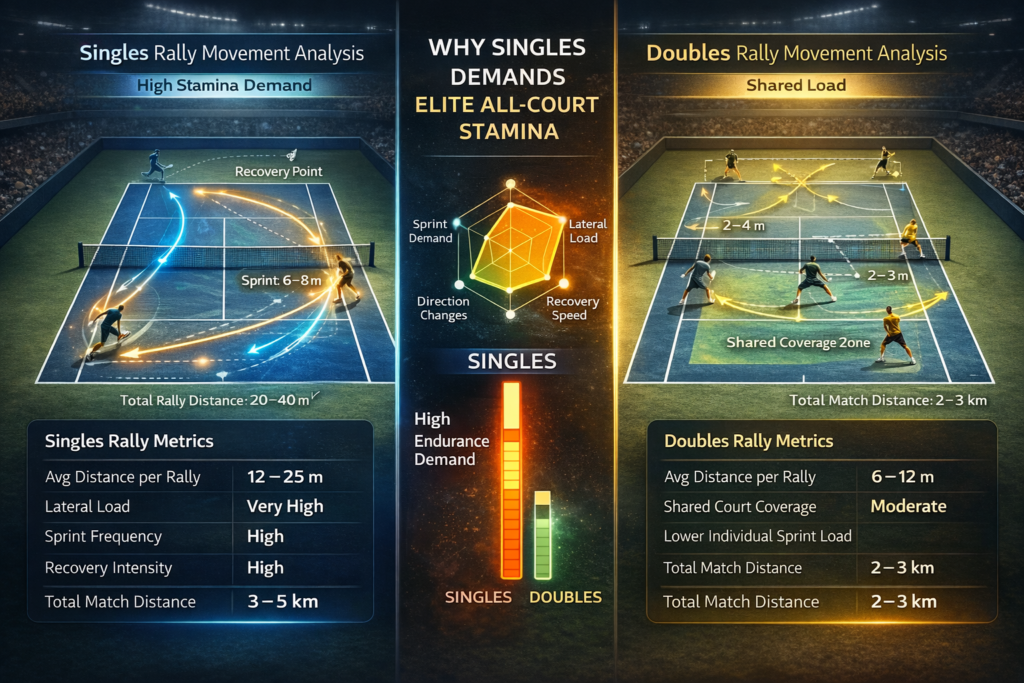
5.3 Singles vs Doubles: A Stamina Contrast
Singles tennis is far more demanding than doubles. In singles, the player covers the entire court alone, handling every shot and every sprint. In doubles, movement is shared, which slightly reduces the stamina load.
Most articles ignore this distinction, but it’s crucial for fair comparisons. A singles match can push even the fittest athletes to their limits, testing continuous effort, intermittent bursts, recovery stamina, and mental focus all at once.
6. Side-by-Side Comparison: How These Sports Stack Up
Now that we’ve explored stamina in football, cricket, basketball, and tennis individually, it’s time to compare them side by side. This section breaks down stamina by duration, intensity, physical demands, and mental focus, giving a clearer picture of which sport tests athletes in different ways.
6.1 Duration vs Intensity Comparison
Football: Matches last 90+ minutes with continuous movement. Players combine moderate-intensity jogging with repeated high-intensity sprints. Stamina here is about sustaining effort over a long period with bursts of explosive activity.
Cricket: Duration varies dramatically by format. Test cricket can last five days, requiring extended physical endurance and mental focus. T20 cricket is shorter but demands frequent high-intensity efforts.
Basketball: Games are shorter (40–48 minutes), but intensity is extremely high. Players sprint, jump, and defend repeatedly, requiring rapid recovery between bursts.
Tennis: Match length is unpredictable. Singles players may spend 3–5 hours on court, performing constant short sprints, lateral movements, and powerful shots. Mental focus compounds the physical demands.
In short, football and cricket test long-duration stamina, basketball tests high-intensity intermittent stamina, and tennis tests combined physical and mental endurance under unpredictable conditions.
6.2 Physical vs Mental Stamina Comparison
- Football: Primarily physical, but mental stamina is essential for tactical awareness, especially in midfield.
- Cricket: Balanced; physical effort varies by role and format, but mental focus dominates in longer formats like Tests.
- Basketball: Mostly physical with bursts of anaerobic effort, but mental stamina is critical for fast decisions under pressure.
- Tennis: Equally physical and mental. Players handle both continuous movement and high-pressure decision-making without teammates to rely on.
This comparison shows that mental stamina is often overlooked in public discussions, yet it plays a decisive role in sports like cricket and tennis.
6.3 Team Sport vs Individual Sport Stamina
One key difference across these sports is the role of team versus individual dynamics:
- Team sports (football, basketball, cricket): Players can share responsibilities, coordinate strategies, and recover mentally by relying on teammates. However, team sports still demand coordination and alertness, adding another layer of mental stamina.
- Individual sports (tennis): Players bear the entire burden alone. Every mistake, every fatigue-induced lapse, directly affects the outcome. Stamina in tennis is therefore more concentrated and unforgiving, combining physical and mental challenges in a way that team sports rarely do.
7. What Sports Science Says About Stamina
Now that we’ve seen how stamina plays out in football, cricket, basketball, and tennis, it’s time to look at what science tells us. Understanding the physiology behind stamina, how the body produces energy, recovers, and performs adds authority to our comparisons and removes guesswork.
7.1 VO₂ Max and Energy Systems Across Sports
One of the most common metrics used to measure stamina is VO₂ max, which indicates how efficiently the body can deliver oxygen to muscles during exercise. A higher VO₂ max generally means better endurance, but it doesn’t tell the full story.
- Football: Players rely on both aerobic and anaerobic systems. Continuous running requires strong aerobic capacity, while sprints and bursts demand anaerobic power.
- Cricket: Especially in Tests, aerobic endurance supports long periods of standing, walking, and batting, while bowlers use anaerobic bursts during deliveries.
- Basketball: High-intensity intermittent sprints depend heavily on anaerobic energy, with aerobic recovery between plays.
- Tennis: Combines both systems in unpredictable patterns, short explosive movements demand anaerobic bursts, while long rallies and matches rely on aerobic endurance.
This shows that VO₂ max alone cannot determine which sport requires the most stamina. The type of energy system a sport emphasizes matters just as much as duration.
7.2 Training Differences Reveal Stamina Priorities
Different sports train stamina in ways that match their demands:
- Footballers often focus on long-distance runs, interval sprints, and tactical drills that combine continuous and high-intensity efforts.
- Cricketers’ conditions for long durations (batting, fielding) include short, explosive movements for bowling and fielding.
- Basketball players emphasize short, repeated sprints, jumps, and recovery speed to handle the game’s constant bursts.
- Tennis players train for both aerobic endurance and anaerobic power, with footwork drills, rally simulations, and mental focus exercises for long points.
This training insight highlights that stamina is sport-specific. Comparing athletes purely by appearance or match length misses the nuances of their conditioning.
8. Which Sport Requires the Highest Level of Stamina?
After breaking down football, cricket, basketball, and tennis, and examining both physical and mental demands, the big question remains: which sport truly tests stamina the most? The honest answer is that it depends on how you define stamina. Let’s break it down.
8.1 If Stamina Means Long Continuous Endurance
If you’re measuring stamina by duration and the ability to keep moving steadily, football and Test cricket stand out. Football requires 90+ minutes of near-continuous running with sprints interspersed, while Test cricket challenges players to maintain focus and moderate activity over hours or even days.
Here, stamina isn’t just about effort in bursts; it’s about sustaining performance over a long period. Players need strong aerobic capacity and muscular endurance to prevent performance from dropping late in the match.
8.2 If Stamina Means High-Intensity Recovery
If you define stamina as the ability to handle repeated bursts of extreme effort with minimal recovery, basketball and T20 cricket take the lead. Basketball players sprint, jump, defend, and attack repeatedly over 40–48 minutes, relying heavily on anaerobic energy systems. T20 cricket bowlers and fielders experience similar demands in shorter, explosive bursts.
This type of stamina is about recovery speed how quickly the body replenishes energy and maintains performance between high-intensity actions.
8.3 If Stamina Means Mental Toughness Under Fatigue
For mental stamina, cricket (especially Test matches) and tennis dominate. Long periods of concentration, constant decision-making, and pressure situations test the mind as much as the body. A cricketer batting for hours or a tennis player in a five-hour singles match must remain sharp, calm, and precise, even when physically exhausted.
Mental fatigue can reduce performance as much as physical exhaustion, and in these sports, the mind is under almost as much strain as the body.

9. Final Verdict: There’s No Universal Winner
The reality is that stamina is multi-dimensional, and no single sport wins in every category. Football excels in long-duration physical effort. Basketball dominates in high-intensity recovery. Cricket and tennis push mental endurance to the extreme.
The takeaway? The “most stamina-demanding sport” depends on which type of stamina you value. Understanding this allows fans and athletes to appreciate the unique challenges of each sport, rather than arguing endlessly about which one is “the toughest.”
Si deseas necesitas saber donde reservar jets de agua en este lugar, hay distintas alternativas increibles tanto en el sector sur como en diversas zonas como esta conocida zona y la Playa de las Americas. Tienes la oportunidad de localizar alquiler moto de agua Tenerife sur con valores asequibles y aventuras como jet bike safari o aqua safari que fusionan energia y entornos espectaculares. Para posibilidades mas especificas, tambien esta disponible la chance de conseguir motos de agua en Tenerife Los Gigantes o gozar deportes acuaticos en este puerto. Para mas datos sobre fechas disponibles y tarifas, te invito a visitar [url=https://alquilerjetskitf.com]jet safari tours[/url] .
Ademas, Tenerife presenta propuestas para todos los niveles, desde los que comienzan hasta veteranos, con empresas como Jet Hub Tenerife y Adrenalina Jet que ofrecen excursiones en motos marinas y jet ski safaris en areas como Costa Adeje. Si deseas una aventura total y sin riesgos, evalua las excursiones motos de agua Tenerife sur o en diferentes puntos, y no pases por alto que contratar con tiempo siempre ayuda, sobre todo en los periodos de mayor afluencia. Por si lo deseas, el telefono +34 612 345 678 es util para preguntas rapidas.
If you had been tinkering with Suno AI generated tracks, you definitely noticed those pesky distortions that can seriously compromise the listening experience. [url=https://cleanaitrack.top]suno audio cleaner[/url] Good news is, there are some effective ways to clear out Suno glitches using applications like the Suno artifact processor or Suno audio cleaner, which enable you to fix Suno AI flaws and improve the entire sound. These options are especially valuable if you need to polish Suno AI tracks and make voices feel more human.
For those working hard to fix Suno track quality or improve Suno music clarity, online AI music cleaners can be a huge help. You can discover cost-free AI music processor options that make it easy to remove flaws from Suno tracks and even streamline mastering your tracks online. If you’re eager to learn more, check out this link which provides a fantastic platform to fix Suno tracks and optimize your audio without much hassle.
Для выбора надежного партнера рекомендуем ознакомиться с [url=https://media-garage.ru/moya-kollekciya/rejting-sistemnyh-multimedia-integratorov-goroda-moskvy]рейтинг мультимедийных интеграторов[/url], который поможет найти лучших специалистов в Москве.
Рейтинг мультимедийных интеграторов показывает лучших игроков рынка
Если вы хотите надежно оградить свой участок, обратите внимание на [url=https://www.zabor-dlya-dachi-iz-proflista.ru/]дачные заборы из профнастила[/url] — это оптимальное сочетание качества и доступной стоимости.
Профнастил покрывается антикоррозионным составом, что улучшает его эксплуатационные качества.
Если вы планируете строительство жилья, обратите внимание на [url=https://karkasnye-doma-pod-klyuch13.ru]каркасные дома цены[/url] — это современное и экономичное решение для комфортного проживания.
В результате снижаются затраты на энергоресурсы, а атмосфера в помещении становится приятнее.
Идеальное решение для современного интерьера — [url=https://www.dizaynerskiye-stoly.ru/]купить дизайнерский стол[/url], которые подчеркнут ваш вкус и статус.
Лучше применять специализированные чистящие средства и исключать агрессивные химикаты.
This website lets you [url=https://recevoir-des-sms.fr/]temp number[/url] for quick online verification.
Its main benefit is the ability to keep your real number private.
[url=https://www.vorota-otkatnyye-mekhanicheskiye-na-rolikakh.ru/]механические откатные ворота 4 метра[/url]
вариантом для промышленных территорий. Подобные ворота помогают эффективно использовать территорию. Полотно движется вдоль забора, из-за чего въездная зона не загромождается.
Эта система имеет понятный принцип работы. Основой служат направляющая, ролики и рама. Именно поэтому их удобно использовать в повседневной жизни. В условиях частого использования конструкция показывает хорошую устойчивость.
К ключевым плюсам относится высокая служба надежности. Простая механика уменьшает число возможных сбоев. Такой подход особенно ценят в местах с постоянной нагрузкой.
Также стоит отметить хороший уровень защиты. Конструкция уверенно удерживается в закрытом состоянии. Если монтаж выполнен корректно, система работает долго и экономично. В результате владелец получает удобство и снижение затрат.
Их часто используют на частных участках. Они особенно удобны в зонах с ограниченной площадью перед проездом. Также их применяют на складах и производственных объектах.
Эти конструкции выдерживают регулярную эксплуатацию без потери качества. Их преимущество заключается в независимости от электричества. Это делает их удобными в местах с нестабильной подачей энергии.
При выборе важно учитывать вес полотна. Также имеет значение качество направляющих и роликов. Качественные комплектующие обеспечивают мягкое и стабильное движение.
Периодический осмотр заметно увеличивает ресурс системы. Важно поддерживать чистоту механизма и проверять надежность соединений. В результате конструкция сохраняет удобство, прочность и безопасность.