

1. Introduction: The Subtle Magic of Spin Bowling
Spin bowling is one of cricket’s most fascinating arts. At first glance, it might look simple: the bowler flicks the ball with their fingers or wrist, and it spins. But behind that simple action lies a world of strategy, psychology, and precision. Even the most technically sound batsmen can be baffled by a well-disguised spinner.
It’s not just about how much the ball turns on the pitch. Spin bowling challenges a batsman’s mind, timing, and decision-making. One delivery can completely disrupt a batsman’s rhythm, forcing mistakes that change the course of a match.
Example: Imagine a batsman confidently defending a stock delivery, only for the next ball to drift in the air and turn sharply away. Even the best players sometimes have no time to react. That’s the magic of spin.
1.1 The Mental Game: Outthinking the Batsman
Spin bowling is as much about strategy and psychology as it is about physical skill. Modern spinners don’t just rely on turns; they set traps. They watch batsmen’s habits, look for small weaknesses, and plan deliveries to exploit them.
Every ball is a little puzzle. Should the batsman play aggressively, or leave it alone? Should they step forward or back? The spinner wants them to make the wrong choice. This constant mental battle is why spin is called a chess game on the cricket field.
1.2 Modern Masters Who Changed the Game
In today’s cricket, players like Rashid Khan and Adam Zampa have redefined spin bowling. Rashid’s rapid-arm wrist spin keeps batsmen guessing in T20s, while Zampa’s clever variations make him lethal in ODIs. Their success shows that modern spin is a blend of mechanics, creativity, and strategy.
It’s not enough to spin the ball. Bowlers must combine:
- Perfect technique: grip, wrist, and finger precision.
- Clever variations: subtle changes in speed, angle, and flight.
- Psychological tactics: reading the batsman and setting traps.
2. The Mechanics: How Spin Deceives the Eye
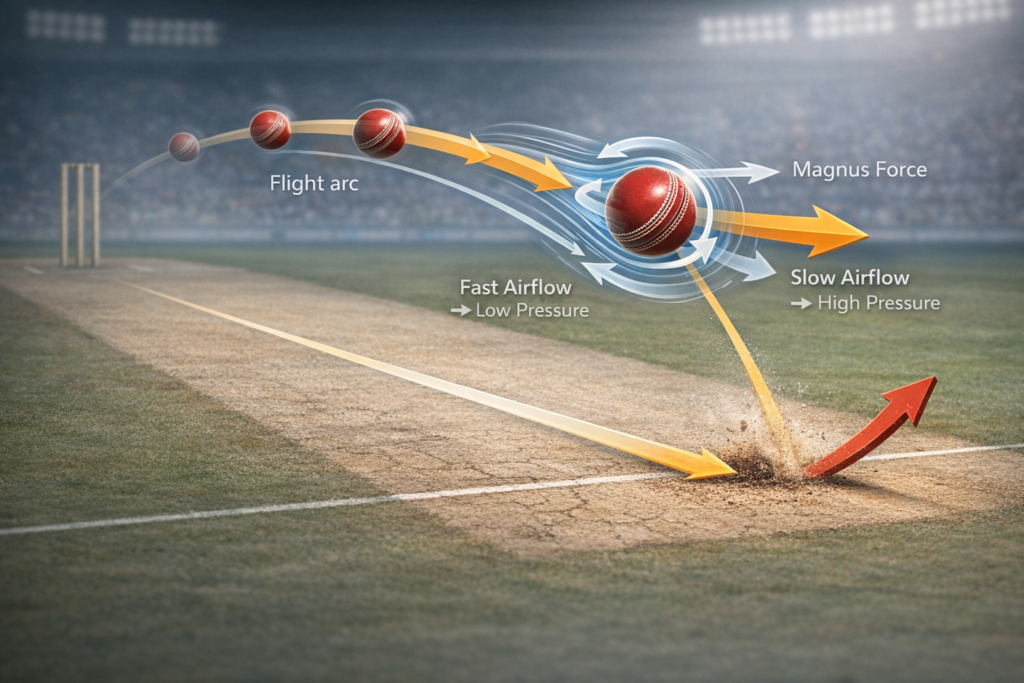
Many fans think spin bowling is simply about making the ball turn on the pitch. In reality, it’s a mix of physics, precision, and timing. A spinner can confuse a batsman long before the ball even bounces.
The secret lies in how the ball moves through the air, how it dips, drifts, and finally spins off the pitch. Each subtle change can make the difference between a perfectly defended ball and a shocking dismissal.
Example: An off-spinner might toss the ball with extra flight. It dips in front of the batsman, who misjudges the length, and suddenly, the ball takes the outside edge. Small changes create big results.
2.1 Types of Spin: Off-Spin vs Wrist-Spin
Spin bowlers generally fall into two categories:
- Off-spin: Typically delivered by a right-arm bowler turning the ball from the off-stump to the leg-stump of a right-handed batsman. It’s subtle and often relies on deception rather than brute force.
- Wrist-spin (Leg-spin): Uses the wrist to turn the ball from leg-stump to off-stump. Wrist spinners can generate more spin and a wider variety of deliveries, making them very tricky to read.
Understanding the difference helps explain why some deliveries look easy but are incredibly hard to play.
2.2 Grip, Release, and Subtle Adjustments
A bowler’s grip and finger position might seem tiny, but they determine how the ball spins and behaves in flight. Even a slight change in wrist angle can completely alter the ball’s movement.
- Finger position controls off-spin or topspin.
- Wrist flicks and rotations create leg-spin, googlies, or flippers.
- The release point can affect trajectory, bounce, and drift.
These micro-adjustments are why reading a spinner’s hand is so critical for batsmen.
2.3 Flight, Dip, Drift, and Bounce: The Invisible Tricks
Spin isn’t just sideways movement. Modern spinners use:
- Flight: Tossing the ball higher to tempt the batsman forward.
- Dip: Making the ball suddenly drop faster than expected.
- Drift: Airborne sideways movement before pitching.
- Bounce: Unexpected variations when the ball hits the pitch.
Each of these factors can trick even experienced batsmen, creating chances for wickets without relying on speed.
Example: A ball drifting slightly away may look like a safe leave, but it spins sharply off the pitch into the pads or stumps.
2.4 Tempo Changes: Speed as a Secret Weapon
Modern spinners often change speed subtly. A delivery slightly faster or slower than expected can disrupt timing. In shorter formats like T20, this can make a huge difference, forcing mistimed shots and edges.
3. Variations and Modern Innovations: Beyond the Basics
Modern spin bowling is more than just off-spin or leg-spin. Top spinners now mix variations, disguise deliveries, and use subtle tricks to keep batsmen guessing. Even if a batsman reads the spin, they can still be caught off guard by clever innovation.
Example: A bowler may bowl a stock off-spin one ball, then follow it with a slower, drifting delivery that looks identical but spins differently. The batsman, expecting the stock ball, can easily misplay it.
3.1 Common Variations Every Spinner Uses
Some of the most effective variations include:
- Googly: A wrist spinner’s deceptive delivery that spins the opposite way to their usual leg-spin.
- Doosra: An off-spinner’s surprise delivery turning the opposite way, often confusing batsmen who expect standard off-spin.
- Carrom Ball: Flicked between the fingers to create unpredictable spin or drift.
- Flipper: Skids low and fast, staying under the batsman’s bat.
- Topspinner: Goes straight on but dips sharply, forcing mistimed shots.
These deliveries are designed to look the same as stock balls, making it almost impossible for the batsman to anticipate.
3.2 Disguise and Deception: The Spinner’s Secret Weapons
Modern spinners don’t just rely on spin; they hide the cues in their hand, wrist, and body position. A tiny flick of the wrist or subtle change in finger position can completely mask the type of delivery.
Example: Rashid Khan often uses the same action for his leg-spin and googly, so batsmen have to guess correctly mid-flight, a risky task even for the best players.
3.3 Modern Innovations: Subtle Yet Deadly
Spinners today also play with speed, angles, and unconventional grips to innovate constantly. These tweaks are often small but have big psychological effects.
- Pace changes: Slightly faster or slower deliveries disrupt timing.
- Angle variations: Bowling from different points or adjusting the wrist angle creates unusual bounce and drift.
- Grip experiments: New finger or wrist positions to generate unexpected spin.
All of these tools allow spinners to control the batsman’s thinking, not just the ball’s path.
3.4 Technology and Analytics in Modern Spin
Top teams now use video analysis, motion capture, and data-driven insights to refine spin techniques.
- Bowlers study batsmen’s weaknesses to plan sequences of deliveries.
- Motion capture reveals small wrist or finger adjustments that change spin behavior.
- Video reviews help bowlers perfect the disguise, making stock and variation deliveries visually identical.
Example: Adil Rashid uses analytics to adjust his flight and drift based on a batsman’s preferred scoring zones, creating high-pressure situations that force mistakes.
4. Mind Games: The Psychology Behind Spin
While flight, dip, and drift are important, the psychological aspect of spin can be even more dangerous. Modern spinners aim to outthink the batsman before the ball even leaves their hand.
Every delivery is a mini battle of wits. A batsman might anticipate the turn, but a spinner can subtly alter the flight or disguise a variation, forcing hesitation or a wrong shot. This mental edge often decides wickets more than raw spin.
Example: A spinner notices a batsman consistently pushes outside balls too early. They might bowl a stock delivery in the same line but slightly slower. The batsman, expecting the usual speed, mistimes the shot and edges it to slip.
4.1 Reading the Batsman: Patterns and Weaknesses
Modern spinners spend a lot of time studying batsmen:
- Do they struggle against balls pitched short or full?
- Do they prefer to play forward or back?
- Are they prone to chasing wide deliveries?
By analyzing patterns, spinners can plan sequences of balls that exploit these weaknesses. It’s like playing chess on the cricket field, every move sets up the next.
4.2 Setting Traps: Deception in Action
Spin bowling is all about creating doubt in the batsman’s mind. Spinners set traps using:
- Stock deliveries to lure the batsman into an aggressive shot.
- Subtle variations that appear identical to the stock ball.
- Field placements are designed to tempt a risky stroke.
Example: Shadab Khan might bowl a fuller off-spin stock delivery with an outside slip in place. The batsman drives, thinking it’s safe, only for a subtle turn or drift to induce an edge.
4.3 Pressure Situations: Making the Batsman Nervous
Spin is especially effective under pressure:
- Death overs in T20s, where runs are needed quickly.
- Middle overs in ODIs, where wickets are crucial.
- Test cricket is where patience is key, and frustration can lead to mistakes.
A spinner doesn’t just aim for the physical wicket; they aim to create doubt, force mistakes, and manipulate the batsman’s emotions.
4.4 Field Placement: Enhancing the Mental Game
Strategic field settings are part of the spinner’s psychological toolkit:
- Positioning slips or close catchers to tempt risky shots.
- Creating gaps where the batsman thinks it’s safe to play, only to trap them.
- Adjusting field angles to control scoring options and force errors.
Field placement reinforces the pressure created by spin, making even technically sound batsmen second-guess their instincts.

5. Modern Masters of Spin: Real-World Examples
Modern spin bowling isn’t just about skill; it’s about consistently applying mechanics, variations, and psychology to dominate games. Certain bowlers have mastered this art and can confuse even the most experienced batsmen.
These spinners are innovators, constantly adjusting their techniques, reading the batsman, and using deception to their advantage. Let’s look at some modern masters.
5.1 Rashid Khan – The T20 Wizard
Rashid Khan’s rise in international cricket has been meteoric. His wrist spin at lightning speed makes it extremely difficult for batsmen to anticipate the ball’s path.
- Signature style: Quick-arm leg spin with minimal telegraphing of googlies.
- Tactical approach: Uses subtle flight and drift to tempt batsmen into attacking shots, often resulting in edges or mistimed strokes.
- Impact: Even top T20 batsmen struggle to score freely against him.
Example: In the IPL, Rashid once bowled four overs without conceding a boundary, creating immense mental pressure with just variations and control.
5.2 Adil Rasid – The Master of Traps
Chahal is known for his strategic thinking. His deliveries are not just about spin; they are set-up sequences designed to force mistakes.
- Signature style: Off-spin with clever variations like the carrom ball.
- Tactical approach: Reads batsman tendencies and sets traps with precise field placements.
- Impact: Often picks up wickets in the middle overs of limited-overs cricket by outsmarting batsmen.
Example: Rasid consistently deceives power-hitters in ODIs by tempting them into lofted drives over in-fielders, leading to simple catches.
5.3 Adam Zampa – The Subtle Manipulator
Adam Zampa has redefined spin in ODIs and T20s with his precision and patience.
- Signature style: Leg-spin with controlled flight and deceptive speed changes.
- Tactical approach: Uses analytics to identify scoring patterns and tailor deliveries accordingly.
- Impact: Makes batsmen second-guess every shot, even those accustomed to facing spin.
Example: In a recent ODI series, Zampa dismissed two top-ranked batsmen in consecutive overs using almost identical deliveries that looked like stock balls but spun differently.
5.4 Sufyan Muqeem – The Rising Star
Sufyan has shown that new-age spinners can also combine strategy and skill to great effect.
- Signature style: Left-arm orthodox with subtle flight variations.
- Tactical approach: Relies on precise lines and lengths to create pressure.
- Impact: Effective in limited-overs cricket, catching batsmen off guard with well-set traps.
6. Format Matters: How Spin Tactics Change Across Cricket
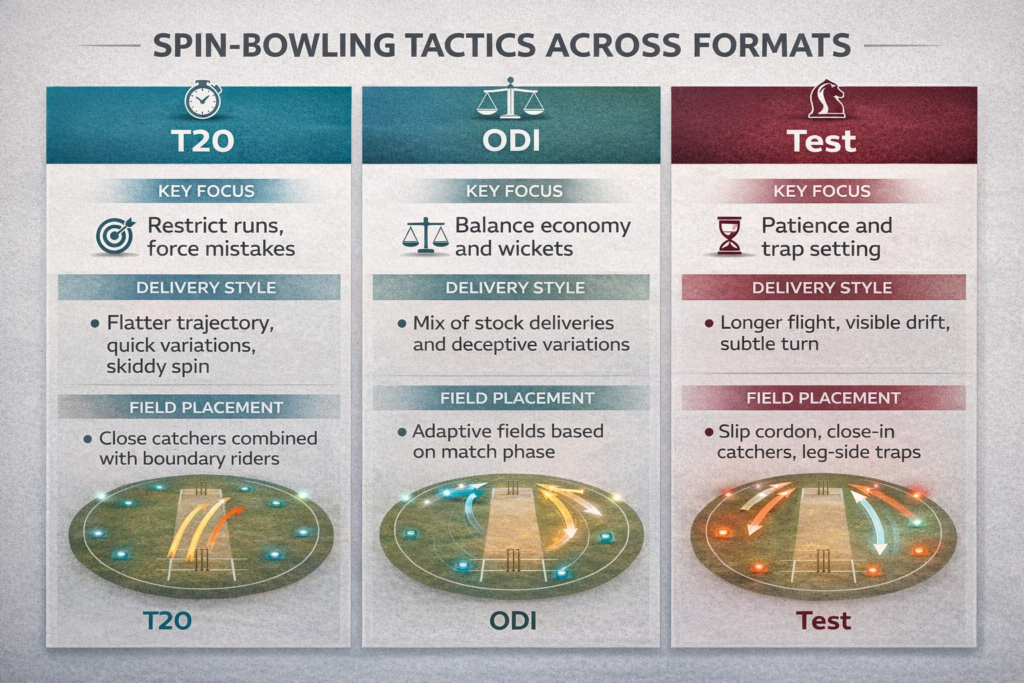
Spin bowling is not one-size-fits-all. The approach a spinner takes in a Test match is very different from T20 cricket. Factors like match duration, scoring pressure, and batsman intent influence how spinners plan and execute deliveries.
Even the best spinners adjust their tactics depending on the format. A delivery that works in Tests might be too slow for T20s, while T20 tricks may be ineffective in the longer game.
6.1 T20 Cricket: Quick Thinking and High Pressure
In T20s, spinners face batsmen looking to score quickly. This demands:
- Shorter flight: Balls are delivered flatter to reduce lofted hitting opportunities.
- Subtle variations: Slower balls, flippers, and quick-arm leg-spin to disrupt timing.
- Strategic placement: Fielders in catching positions to tempt risky shots.
Example: Rashid Khan’s T20 dominance comes from his ability to mix pace, angle, and spin while keeping the batsman under constant mental pressure.
6.2 ODIs: Balancing Wickets and Economy
In One-Day Internationals, spinners must:
- Control the scoring rate: Prevent easy boundaries while setting up wickets.
- Mix deception with consistency: Use stock deliveries to build pressure before variations.
- Adapt to match phases: Powerplays, middle overs, and death overs require different strategies.
Example: Adam Zampa often bowls stock leg-spin in the early overs, then switches to a subtly slower googly in the middle overs, forcing batsmen to misread pace and turn.
6.3 Test Cricket: Patience and Subtlety
In Tests, spinners have the luxury of time, but the challenge is different:
- Flight and drift are key: Longer deliveries tempt batsmen to attack and create edges.
- Trap setting: Extended sequences set up a batsman mentally before delivering the wicket-taking ball.
- Endurance and consistency: Maintaining line and length over long spells is crucial.
Example: Kuldeep Yadav, left-arm orthodox spin in Tests, uses consistent flight and subtle drift to lure batsmen forward, often leading to catches in slips or close fielders.
7. Challenges for Batsmen: Why Even the Best Struggle
Facing a top spinner is not just about technique; it’s a mental challenge. Even elite batsmen must make split-second decisions under pressure, and spinners exploit every small hesitation.
- A perfectly disguised delivery can force a batsman to second-guess their instincts.
- Variations in flight, turn, and speed make timing extremely difficult.
Example: A batsman expecting a stock off-spin might advance confidently, only for a slower, drifting delivery to slip past the bat or take the edge.
7.1 Pitch Conditions Can Make or Break the Batsman
Spinners often benefit from pitches that:
- Offer an extra turn or bounce.
- Have inconsistent pace, making judging flight and timing difficult.
- Gradually deteriorate over the match, increasing unpredictability.
Even experienced batsmen struggle when conditions amplify the spinner’s natural advantage.
Example: In subcontinent Tests, pitches with sharp turn have led to several top-ranked batsmen being dismissed cheaply by young spinners like Jayawickrama.
7.2 Evolution of Batting Techniques vs Modern Spin
Modern spinners have forced batsmen to adapt their techniques:
- Using wristy shots, sweep shots, or stepping out to negate spin.
- Developing anticipation skills to read hand cues.
- Learning to manage mental pressure and patience, especially in Tests.
Despite these adjustments, even seasoned players are sometimes caught off guard by:
- Subtle changes in speed or drift.
- Unexpected variations like doosras, flippers, or carrom balls.
- Clever field placements that create traps.
7.3 Statistics: Top Batsmen Struggle Against Spin
- Data shows that some elite batsmen have lower averages against top spinners in all formats.
- For example, many international batsmen have dismissal rates against Rashid Khan in T20s exceeding 20%, even though they are accustomed to spin.
- Test match statistics highlight that young spinners with smart flight and trap-setting often claim wickets with minimal turn, emphasizing strategy over brute spin.
These numbers prove that skillful spin can outthink experience.
8. Conclusion: Spin as a Blend of Art, Science, and Strategy
Spin bowling is not just a skill; it’s a thinking man’s craft. It combines science, experience, and psychology into one elegant weapon. The best spinners don’t rely on magic deliveries every ball. They rely on planning, patience, and pressure.
Throughout this article, one thing becomes clear: spin bowling works because it attacks the batsman on multiple levels at once. The eyes are deceived by flight and drift. The hands are tested by turn and bounce. And the mind is challenged by uncertainty.
8.1 Modern Spin Is Smarter Than Ever
Today’s spinners are more prepared, more analytical, and more adaptable than ever before. Players like Rashid Khan and Adam Zampa show that success doesn’t come from brute spin alone.
It comes from:
- Understanding the batsman’s habits
- Using variations sparingly but effectively
- Adjusting tactics across formats
- Applying constant mental pressure
This evolution proves that spin bowling is not dying in modern cricket; it’s evolving.
8.2 Why Batsmen Will Always Struggle Against Spin
Even the best batsmen struggle because spin bowling never offers certainty. A delivery that looks harmless can dip late. A stock ball can behave like a variation. A familiar field can hide a trap.
That uncertainty is what makes spin bowling timeless. As long as cricket is played, batsmen will be tested not just on skill but on judgment, patience, and nerve.
8.3 The Final Takeaway
Spin bowling sits at the crossroads of art, science, and strategy. It rewards intelligence as much as talent and experience as much as skill.
For fans, it’s a joy to watch.
For bowlers, it’s a lifelong craft.
For batsmen, it’s the ultimate exam.
And that is why spin bowling will always remain one of cricket’s most beautiful and dangerous arts.